

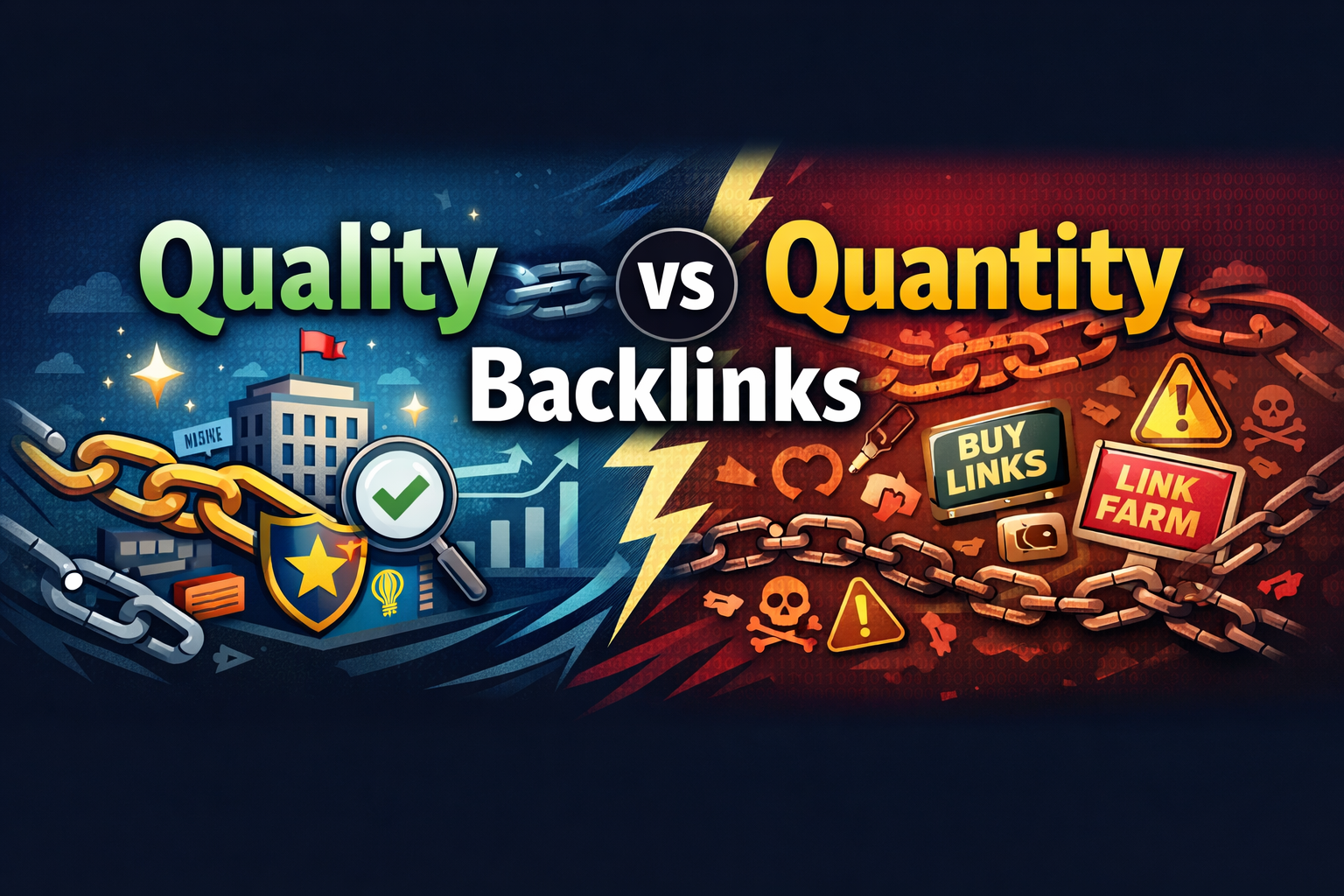
Quality vs Quantity Backlinks: What Really Matters in Modern SEO?
Backlinks have always been one of the most powerful ranking factors in search engine optimization. They act as votes of confidence, signaling to search engines that your website is trustworthy, authoritative, and worth ranking.
But one question still dominates conversations between business owners, marketers, and SEO agencies:
Should you focus on quality backlinks or quantity (number of backlinks)?
The short answer: quality beats quantity — but only when done strategically.
The long answer? Let’s break it down properly.
Understanding What Backlinks Really Do
A backlink is a hyperlink from one website to another. From a search engine’s perspective, backlinks help determine:
- How authoritative your site is
- How relevant your content is to a topic
- How trustworthy your brand appears online
However, not all backlinks carry the same weight. A single backlink from a respected, authoritative website can be worth more than hundreds of low-quality links from spammy sources.
Search engines don’t just count links — they evaluate them.
What Are “Quality” Backlinks?
A quality backlink comes from a website that has strong authority, relevance, and trust. These links send powerful signals to search engines and often drive real referral traffic as well.
Key Characteristics of a Quality Backlink
- High Domain Authority
Links from websites with strong domain authority (news sites, industry leaders, reputable blogs) pass significantly more value. - Topical Relevance
A backlink from a website in your industry or niche is far more powerful than a random link from an unrelated site. - Editorial Placement
Links that are naturally placed within valuable content (not footers, comments, or directories) perform better. - Contextual Anchor Text
When the anchor text fits naturally into the content and aligns with your target keywords, it strengthens SEO signals. - Organic Traffic
Websites that actually receive traffic pass more value than sites that exist only to sell links.
What Are “Quantity” Backlinks?
Quantity backlinks focus on how many links point to your website, regardless of their quality.
This strategy was popular years ago when search engines were easier to manipulate. SEO tactics like:
- Link farms
- Automated directory submissions
- Blog comment spam
- Private Blog Networks (PBNs)
…worked temporarily.
Today, these tactics are risky and often harmful.
Why Quantity Alone No Longer Works
Search engines have evolved dramatically. Their algorithms now analyze backlink profiles in depth, looking for patterns that suggest manipulation.
Risks of Focusing Only on Quantity
- Algorithmic penalties
- Manual penalties
- Ranking drops
- Loss of domain trust
- De-indexing in extreme cases
A website with 5,000 low-quality backlinks but no authority will almost always lose to a site with 50 high-quality, relevant backlinks.
Quality vs Quantity: A Clear Comparison
Quality Backlinks
Pros
- Strong SEO impact
- Long-term ranking stability
- Higher trust and authority
- Referral traffic
- Brand credibility
Cons
- Time-consuming to acquire
- Requires strong content
- Often costs more effort or budget
Quantity Backlinks
Pros
- Faster to build
- Short-term visibility (sometimes)
- Can support natural-looking link velocity if done carefully
Cons
- High risk
- Low SEO value
- Potential penalties
- Often zero referral traffic
What Google Actually Wants
Search engines aim to rank the best possible result for the user. That means they reward websites that:
- Publish valuable, original content
- Earn links naturally
- Build authority over time
- Receive mentions from trusted sources
A natural backlink profile usually includes:
- A small number of very strong links
- Some medium-authority links
- A limited number of low-authority mentions
What it does not include:
- Hundreds of identical anchor texts
- Links from unrelated niches
- Sudden unnatural link spikes
The Ideal Backlink Strategy: Quality First, Quantity Second
The smartest SEO strategy is not choosing one over the other, but prioritizing them correctly.
Step 1: Focus on Quality as the Foundation
Start by earning links from:
- Industry blogs
- Digital publications
- Business partners
- Guest posts on relevant websites
- High-quality PR placements
These links build authority and trust.
Step 2: Scale with Controlled Quantity
Once authority is established, you can safely add volume through:
- Brand mentions
- Local citations
- Niche directories
- Digital PR syndication
- Social proof links
This helps create a natural link profile without triggering red flags.
Why One High-Quality Link Can Beat 100 Weak Ones
Let’s put it simply:
A backlink from a respected industry publication:
- Passes authority
- Drives referral traffic
- Improves brand recognition
- Helps multiple keywords rank
100 low-quality links:
- Pass little to no authority
- Often ignored by search engines
- Can harm trust signals
- Rarely drive traffic
SEO today is about impact, not volume.
Backlinks and Business Goals
As a digital marketing agency, it’s important to remember:
SEO isn’t just about rankings — it’s about results.
Quality backlinks:
- Attract better leads
- Improve conversion rates
- Strengthen brand positioning
- Support long-term growth
Cheap bulk links might look impressive on a report, but they rarely move the needle where it matters: revenue.
Common Client Misconceptions About Backlinks
- “More links automatically mean higher rankings”
Not anymore. - “All backlinks are good backlinks”
Some links are worse than having no links at all. - “Cheap link packages are safe”
They’re often the fastest way to damage a site. - “Backlinks work instantly”
High-quality links take time to show full impact — but the results last.
How to Explain This to Clients Simply
If a client asks whether they should focus on quality or quantity, the easiest explanation is:
“We focus on quality first because one strong recommendation from a trusted source is worth more than a hundred random mentions.”
This builds confidence and positions your agency as a strategic partner — not a link seller.
Final Verdict: Quality Wins (Every Time)
In modern SEO, quality backlinks are non-negotiable. Quantity only matters when it supports a natural, authoritative profile.
If you’re serious about:
- Sustainable rankings
- Brand authority
- Long-term traffic growth
Then your backlink strategy should always follow this rule:
Earn trust first. Scale second.
That’s how real SEO success is built — and how agencies deliver results that actually last.
Add comment